The Week You Cannot Buy Back: A Conference Audit for the Executive Researcher
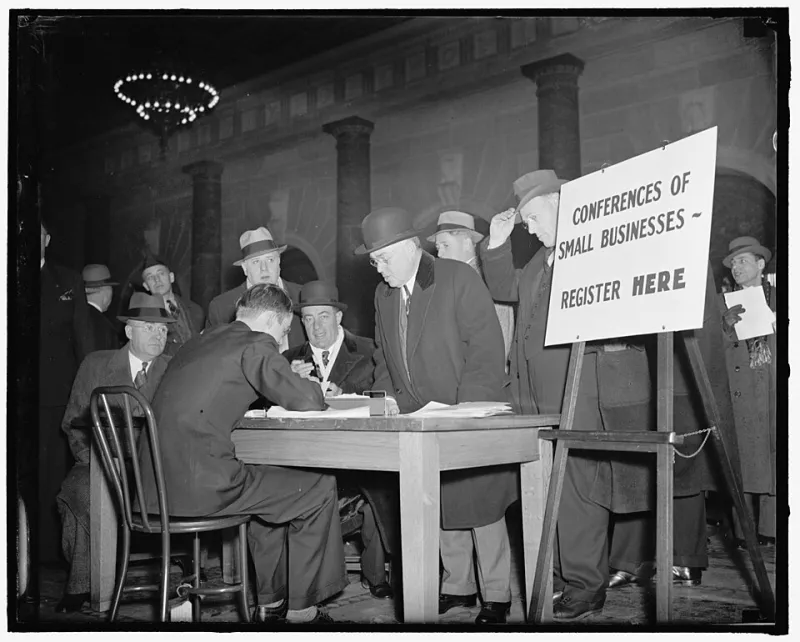
Photo: Harris & Ewing, photographer, Public domain, via Wikimedia Commons
Every doctoral handbook encourages conference attendance. Very few tell the executive researcher what a week actually costs. For a full-time PhD student, a conference is a low-marginal-cost event measured in student rates and shared accommodation. For a UK executive three years into a DBA, it is annual leave, a rearranged board schedule, a train fare or a flight, a hotel in a city centre during term time, and seven days in which the thesis does not move.
That does not make conferences a poor investment. It makes them an investment that should be underwritten. Below are seven tests worth applying before a calendar entry becomes a booking.
1. Who will be in the room, precisely?
'Academic audience' is not an audience. Ask for last year's programme and read the session list. Are the papers closest to yours presented by doctoral candidates, early-career researchers or established scholars? Is there a doctoral consortium, and is it led by people whose work you cite?
A useful discipline: identify three named people you would want to speak to, and check whether they actually attended the previous edition. If you cannot name three, the event is unlikely to repay a week of your time.
2. Is the feedback structural or ceremonial?
Conference feedback varies enormously in quality. A fifteen-minute slot with five minutes of questions produces polite observations. A dedicated doctoral workshop, a discussant-led stream or a roundtable with pre-circulated papers produces something you can take back to your supervisor.
Ask whether the event publishes full papers, whether discussants are assigned, and whether there is a follow-up mechanism. Where the format is purely presentational, be honest that you are buying visibility rather than critique — and value it accordingly.
3. What does the week cost in total, not in registration?
Registration is the smallest line. Build a full reckoning: travel, accommodation, subsistence, the leave days consumed, and — if you are self-funding or using employer support — the cash equivalent of those days. Add the substitution cost of the meetings you will miss.
UK-based researchers have a modest advantage here: several major management and public policy events are held domestically, and a two-day attendance with a single overnight is a materially different proposition from a five-day international trip. Where an overseas event is genuinely necessary, consider whether a shorter attendance — arriving for your session and the doctoral workshop only — captures most of the value.
4. What are the leave and disclosure implications?
Doctoral study sits awkwardly beside employment, and conference travel is where that awkwardness becomes visible. Check three things before booking: whether your contract requires you to declare external activity, whether your employer's support agreement covers time away (see any written backing you negotiated at enrolment), and whether the dates collide with a fixed commitment such as a year-end close, an inspection or a board cycle.
A conference that requires you to be absent during a period you cannot credibly leave is not a scheduling problem. It is a signal that the event is wrong for this stage of the year.
5. Is presenting genuinely better than attending?
Presentation carries a line on the CV and a deadline that forces the paper into existence. That deadline is often the most valuable part of the transaction: it converts a half-drafted chapter into a structured argument and a set of slides you can reuse at your progression panel.
But presenting badly — a rushed paper, an unfamiliar audience, a session that clashes with the people you came to meet — can cost more than it returns. If the choice is between a weak presentation at a large event and attentive attendance at a smaller one, the smaller event usually wins in the second and third year of a DBA.
6. Will anything survive the return journey?
Judge the event by what it produces ninety days later. Realistic outputs include a revised chapter structure, two or three references you had missed, a named contact for access or data, a co-author conversation, or a paragraph of examiner-proof framing for your contribution.
Before booking, write down what you expect to bring back. After attending, check whether you did. Two consecutive events that produce nothing usable are evidence about your selection, not about conferences in general.
7. Does it serve the thesis, the portfolio, or neither?
Late in a DBA, the calculus shifts. Early on, an event that broadens your reading and introduces you to the scholarly conversation is worth a week. Later, the question becomes whether the event feeds the submission or the post-viva portfolio: a policy roundtable, an industry-academic symposium or a practitioner conference may do more for your transition than a purely academic stream.
Be explicit about which purpose you are serving. An event that serves neither the current chapter nor the future portfolio is, however enjoyable, an expense.
A standing rule
Executive researchers rarely regret attending one well-chosen event a year. They frequently regret the cumulative drift of three or four marginal ones. The audit above takes twenty minutes and applies to every invitation that arrives in your inbox.
Apply it before the early-bird deadline, not after. The week is the scarce resource; the registration fee is only the receipt.